
Artikel Maatschappij en samenleving
Infographic: kinderen en technologie

Het is soms verbazingswekkend om kinderen, anno 2012, om te zien gaan met technologie. Als ik de vergelijking trek met de technologie waarmee ik in mijn jongere jaren mee in aanraking kom dan is er weinig overeenkomst. Het gaat razendsnel.
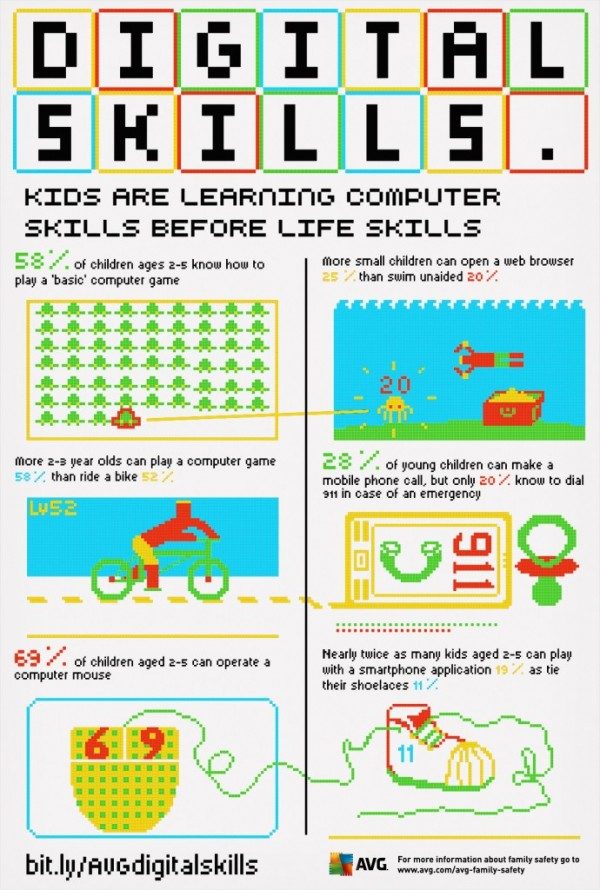
Digitaal is normaal en we zien nu zelfs een sterke tegentrend ontstaan die ons wat bewuster doet omgaan met de vele technologische mogelijkheden. De trend contra digitaal is zonder meer een uiterst interessante tegentrend die steeds meer voedingsbodem vindt. De onderstaande infographic is onder andere samengesteld van onderzoek door Digital Diaries. Een web initiatief dat zich richt op ouders te helpen om te gaan met hun steeds meer digitale kinderen.
Onderstaand de in de infographic opgenomen cijfers uit het onderzoek van onder andere Digital Diaries.
1 – 81% of children under two currently have some kind of digital dossier or footprint, with images of them posted online. In the US that rises to 92%
2 – Though the average digital birth of children happens at around six months, a third (33%) of children have information and photos online within weeks of being born. In the UK, 37% of newborns have an online life from birth, whereas in Australia and New Zealand the figure is 41%
3 – A quarter (23%) of children have had their pre-birth scans uploaded to the Internet. This figure rises to 34% in the US, while in Canada the figure is even higher at 37%. Fewer parents share scans of their children in France (13%), Italy (14%) and Germany (15%)
4 – More small children can play a computer game than ride a bike. 58% of children aged 2-5 know how to play a ‘basic’ computer game. For the UK and France that jumps to 70%. Even 44% of 2-3 year olds have the ability to play a computer game. By comparison, 43% of kids 2-3 can ride a bike
5 – There is no tech gender divide between young boys and girls. As many boys (58%) as girls (59%) can play a computer game or make a mobile phone call (28% boys, 29% girls)
6 – More than half (51 percent) of 6- to 9-year-olds use some kind of children’s social network such as Club Penguin or WebKinz. However, 58 percent of their parents admit they are not well-informed about their children’s online social networks
7 – Despite Facebook in theory barring access to the under 13s, in Spain and Italy most are on at age ten, in the US, US, UK, Canada, France, Australia, New Zealand it is 11, while in Germany most ‘graduate’ to these sites at 12. Across all countries children reach so-called social media maturity at 11
8 – A majority of parents in the USA (61%), Spain (61%), Italy (54%) and Canada (54%) admit to secretly accessing their teen’s Facebook account without them knowing. Across all 11 countries, 44% admitted to doing this with mothers (49%) more likely to check up on their teenage kids than fathers (39%). Though 48% of parents of 14 year old children access their kids’ Facebook accounts, a significant (40%) number of parents of 17 year olds still do so.
9 – A majority of parents in Spain (65%) and Italy (57%) fear that what their teens’ post on social networks now will harm their college, career or dating prospects in the future. In the US (40%) and Australia (42%) around 40% are concerned, while UK parents are somewhat more relaxed with only 30% being worried about their teen’s digital footprint.
10 – UK parents in particular give their kids’ teachers high marks with 59% saying that they do a good or very good job of preparing teens’ for digital adulthood, compared with 21% that feel they do a bad job.
Tekst Lies damned lies statistics.
Lees ook

Effect mobiele apparaat op gezondheid (infographic)
Wat is het effect van onze toenemende verslaving aan ons mobiele apparaat? Er is toenemend onderzoek naar maar wat nu daadwerkelijk de effecten zijn, is niet altijd…

Europa's 'schuldencrisis' in een infographic
Wat is de omvang van de schuldencrisis in Europa? We de stress is weer flink in de financiële wereld geschoten en de vraag is of de maatschappij zich ook zo druk maakt. Laten we…

Infographic: Toename internetgebruikers
We weten dat de komende jaren het aantal mensen die gebruik maakt van het internet exponentieel toeneemt. Hierbij is de grootste toename trouwens niet mensen online maar apparaten…

Infographic: de student verslaafd aan technologie?
Wat is een verslaving? Volgens een definitie in Van Dale: De zodanige fysieke of psychologische gewenning aan een substantie of gewoonte dat het beëindigen hiervan ernstige…

Infographic: het internet in 2020
Hoe ontwikkelt het internet zich tot het jaar 2020? Een moeilijke voorspelling maar toch probeert deze infographic wat inzichten te geven.

Infographics: Facebook economie en omvang internet
Weer twee mooie en handige infographics. Ik vond ze in ieder geval het vermelden waard. Vandaag Facebook en de omvang van het Internet

Infographics: Youtube en mobiele apps
Sinds kort besteed ik wekelijks op Extend Limits wat aandacht aan mooie en vooral informatieve infographics. Deze week een infographic over YouTube en de opkomst van de App's.

Opkomst internet verslaving (infographic)
We kunnen niet meer zonder...tenminste daar lijkt het op. Om voor mezelf te spreken...ik kan niet meer zonder...maar dat komt ook door mijn werk. Maar de mens raakt steeds meer…

Status van social media privacy (infographic)
In toenemende mate horen we hoe diverse 'social media diensten' onze privacy niet zo nauw nemen. Wat is nu de status van privacy en social media? Deze infographic probeert een…

Infographic: Mobiele data trends 2020
We leven in een data maatschappij en dat neemt alleen maar toe. Data wordt de nieuwe brandstof van de wereld. Maar hoe staat het met de groei van data en wat kunnen we verwachten?…

